
The Mullah Regime’s Assault on Digital Freedom: Lessons from Iran and the Taming of Global Net Politics
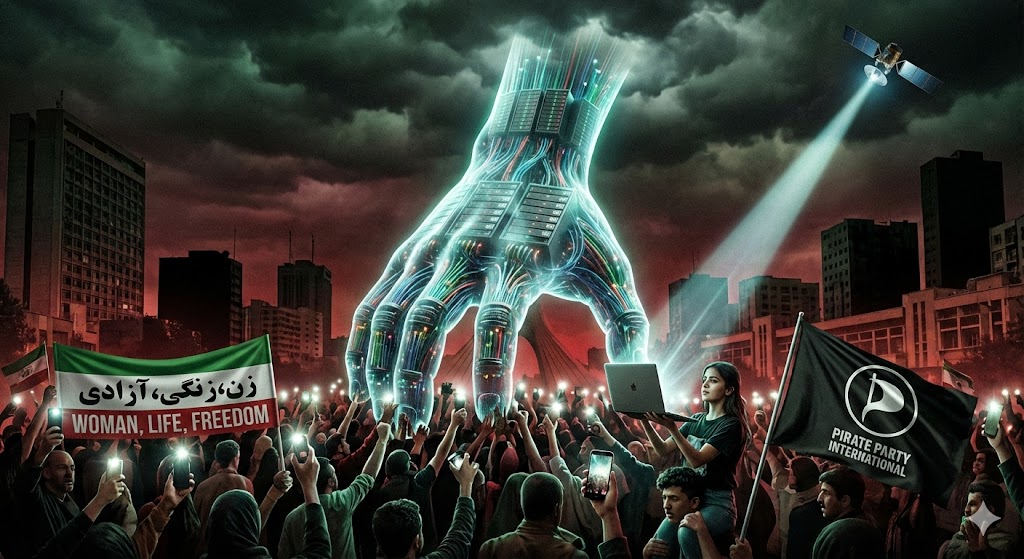
By Schoresch Davoodi, Board Member of Pirate Party International, Delegate for European Policy and Member of the Foreign Policy Working Group in Pirate Party of Germany
Published in Pirate Times, January 9, 2026
The protests raging across Iran since late December 2025 lay bare the Mullah-Regime’s vulnerability—and its ruthless reliance on digital repression to survive. Born from economic desperation—galloping inflation, blackouts plunging cities into darkness, and water shortages threatening survival—these demonstrations have swiftly transcended grievances, erupting into a nationwide demand for the Islamic Republic’s downfall.
In Tehran, Isfahan, Shiraz, and dozens more cities, voices rise in unison: “Death to the Dictator,” aimed squarely at Supreme Leader Khamenei. This is not transient anger but a profound revolution against a regime that lavishes billions on proxies like Hamas, Hezbollah, and the Houthis while its people endure crumbling infrastructure and environmental collapse.
Tehran itself, once a beacon of modernity, now embodies this decay—its ground sinking, its air toxic, as I recently highlighted on X linking to a stark video: “How Tehran Became an Awful Place to Live”. From my family’s enduring resistance to tyranny and my work in the Pirate Party International (PPI), I see Iran’s crisis as inseparable from a worldwide erosion of digital freedoms: the “taming” of online activism in the West and the selective hypocrisies that fracture universal human rights.
The Digital Siege
The regime’s survival hinges on a meticulously engineered digital siege. Cloudflare and NetBlocks data confirm a 30-40% plunge in traffic, with pinpoint blackouts in hotspots and relentless VPN assaults—tools outlawed without state approval since 2024. This is no accident; it is designed to fracture coordination, bury atrocity evidence, and isolate protesters from the world, turning their fight invisible.
In my 2023 Flaschenpost interview, I exposed the regime’s relentless fabrications, mirrored by its “Axis of Autocracies” allies—Russia, China, Iran—in corrupting open discourse. They insist only “leftist” revolts are authentic, a Soviet relic I’ve repeatedly challenged, dismissing Iran’s organic uprising as foreign-orchestrated while throttling its digital pulse. Such deceit exposes a deeper rot: fierce outrage against certain censors, yet tacit tolerance when ideology aligns.
The “Taming” of Net Politics
This Iranian ordeal finds a chilling parallel in Babak Tubis’s piercing January 2, 2026, PPI piece, “The Taming of Net Politics: HateAid as a Cautionary Tale for Digital Freedom”. As my PPI colleague and Iranian-rooted advocate, Tubis reveals how grassroots digital activism surrenders to state symbiosis, losing its defiant edge.
HateAid, launched to shield hate victims, became a Digital Services Act (DSA) “Trusted Flagger,” only to incur U.S. sanctions amid transatlantic digital strife in December 2025. Tubis captures the peril:
“HateAid fits this pattern perfectly. As a state-funded organisation with accelerated flagging privileges under the DSA’s trusted-flagger framework, it has moved from grassroots support for victims of online violence into a semi-institutional role inside the regulatory apparatus.”
This exposure invites autocrats to exploit legal levers for suppression. As I questioned on X: “Is fighting online hate worth trading digital freedom for state ties & censorship tools? Pirate Parties warn: HateAid’s path shows the risks.” Western excuses for censorship—”protecting democracy” from misinformation—eerily echo the Mullahs’ blackout justifications, eroding Kantian Mündigkeit, our capacity for independent thought, in favor of technocratic overseers.
The Silence of the Left
Our Pirate heritage, forged in Enlightenment principles, demands we confront hatred without sacrificing pluralism or trading autonomy for institutional favor. In Iran, regime disinformation permeates Western channels via lobbyists and influencers, breeding unchallenged myths. I’ve long unmasked German left-wing parties—the SPD and Greens—tethered by historic bonds to the Islamic Republic, recycling Soviet narratives that undermine legitimate opposition.
The Pirate Party Hesse’s 2023 indictment, “Proteste im Iran – und die politische Linke schaut weg”, stands as a beacon: the left bypasses a truly progressive revolution it should champion, favoring doctrine over universal rights. Hesse embodies consistency, upholding digital and liberal freedoms as indivisible. By contrast, Baden-Württemberg, despite past boldness (such as their September 2024 probe of political Islam), has offered no voice on this latest surge.
These inconsistencies lay bare ethical fractures, illuminated in Hesse’s 2025 reflection by Nasrin Amirsedghi, “Freiheit, die den Hass schützt – Frankfurt und der moralische Bankrott”. It probes how assembly rights can harbor venom, bolstering democracy’s enemies much like Mullah agents exploit Western indulgence for propaganda.
A Call for Solidarity
PPI’s January 3, 2026, affirmation, “Solidarity with Iran: PPI Supports the Path to a Democratic Future”, anchors our resolve. We envision a secular democracy amplifying liberties, urging an Iranian Pirate Party for non-violent digital resistance—via tools like Starlink, long my advocacy against throttling.
The regime totters. Victory requires urgency:
- Compel Elon Musk for Starlink access.
- Expel regime diplomats and sanction oppressors.
- Demand the Revolutionary Guards’ listing as a terrorist organization.
As I declared on X honoring Hannover’s Jina Mahsa Amini square: Freedom defies borders; we champion it everywhere. The Islamic Republic will soon be a dark footnote in the history of Iran. Democracy rises.
